Oxygen & nitrogen generation systems · ISO 9001 & ISO 13485 registered

Home » Oxygen Solutions » Medical Oxygen Industries »
Oxygen Technology Markets

On-site oxygen
PCI offers the complete package when it comes to oxygen generation, storage, and distribution to support medical professionals and the respiratory needs and situations of their patients.
Today, more than ever before, hospitals worldwide have realized that on-site oxygen generation provides a highly reliable and economic solution for oxygen therapy needs and other oxygen requirements. Besides direct supply to the hospital house supply line, an on-site oxygen system can be designed to include the capacity to fill cylinders to provide backup, peak, and remote oxygen requirements.
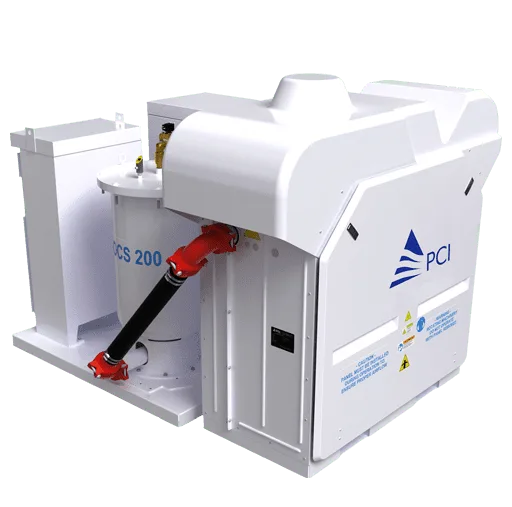
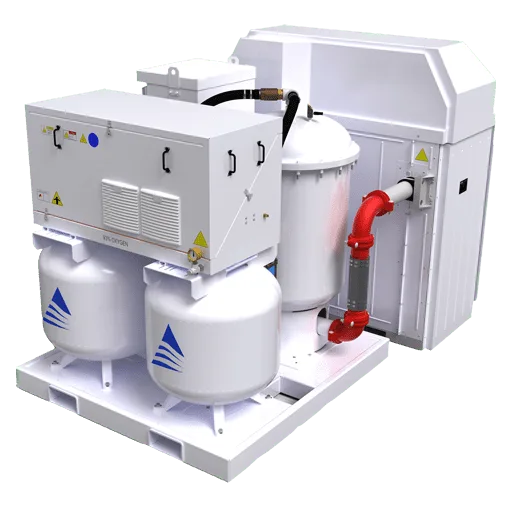
PCI’s DOCS systems can be used in any medical application, from supplying oxygen directly to the hospital’s house supply line to filling cylinders for emergencies and remote applications.
Healthcare professionals across the medical industry rely upon PCI’s VSA technology to reliably deliver medical grade oxygen to their patients.
Compare hospital oxygen generator models
80 – 500 lpm
MDOCS oxygen flow range at 93% purity
93% ± 3%
Medical grade oxygen (USP / Ph. Eur.)
~50% less energy
Than a PSA of equivalent size and delivered pressure
Hours, not days
Installation time for a turn-key system
Why on-site oxygen
Our mission is to enable you to have autonomy in your Oxygen supply.
With full certification from all major pharmacopeia monographs (WHO,USP,EP), PCI’s DOCS systems aim to help you take control of your oxygen supply and empower you to provide the best care possible at all times.
Hospital supply design
Oxygen requirements at hospitals vary greatly depending on the needs of operating rooms and intensive care units. As it is imperative that the hospitals always get the oxygen they need, the design of an onsite oxygen system must address this varying need. In many cases the peak requirement may be three to four times the average rate.
While the DOCS has the capability to adjust its production rate, clearly it cannot meet the requirement when the machine has to be taken down for maintenance or for periods of loss of power. To cover all these eventualities ISO 10083 recommends two additional redundancies besides a primary generator. The second source can be another generator, vaporized LOX or a cylinder bank. The third source must be a dual cylinder bank with automatic switching between the banks.
No two hospitals are the same, so it is very important to analyze the oxygen needs before designing the appropriate system.

Primary source: on-site DOCS oxygen generator
Second source: another generator, vaporized LOX or a cylinder bank
Third source: a dual cylinder bank with automatic switching
A typical integrated on-site oxygen supply system encompasses an array of connected components, tailored to produce and deliver a consistent, dependable source of oxygen
How it works
Based on existing technology used in its military medical oxygen generators, PCI developed a commercial line of on-site oxygen generators:
Lowest operating cost in its class
Most reliable technology
Extremely low power consumption
Very few components = low maintenance cost
PCI Gases manufactures Deployable Oxygen Concentration Systems (DOCS), utilising a single bed state of the art VSA technology. This system is one of the most reliable, robust and cost-effective sources of on-site oxygen generation systems available.
Utilising a single blower to both supply air to the VSA as well as remove the nitrogen and other contaminant gases from the VSA bed reduces both capital costs as well as operational costs when compared to a PSA of comparable capacity.
PCI’s Load Following feature saves energy by slowing down the VSA blower motor during periods of reduced flow.
Technology
The medical industry now accepts the advantages PCI’s Vacuum Swing Adsorption (VSA) technology has over that of conventional Pressure Swing Adsorption (PSA). This is due to VSA’s simple design, energy efficient technology, ease of maintenance, and lowest total cost of ownership.
To produce oxygen from air, PCI uses a proprietary Vacuum Swing Adsorption (VSA) process that maximizes sieve and power efficiencies. Such efficiencies translate into low operating costs for oxygen generation.
A VSA will save approximately 50 percent of the energy consumption over a PSA of equivalent size and delivered pressure. A VSA also eliminates 33 percent of the main components and 70 percent of the process valves, which increases its reliability and significantly reduces its maintenance costs.
Power (kWh/m³)
PSA
1.3 – 1.5
PCI VSA
0.65
Main components
PSA
6
PCI VSA
4
Process valves
PSA
10
PCI VSA
3
Factory Tested and Certified
Easy Installation (Hours not Days)
Uses Half the Power of Traditional PSA’s
No Air Compressor and Dryer Required
Oil-Free Design and Integrated Safety Features
Energy Saving Load Following Capabilities
Single Bed VSA Minimizes Process Valves and Manifolds
Remote Monitoring and Diagnostics Capabilities
Modular Design Offering Flexibility
Simple Operation and Easy to Maintain
Minimal Space Requirement
Minimal Civil Construction Work Necessary
All of these features reduce the cost of preventative maintenance and repairs, thereby reducing the operating cost.
Lower your cost of oxygen
Why pay an Industrial Gas company to supply your oxygen requirements when you can generate your own Oxygen? With a PCI Gases DOCS onsite Oxygen Generating System you can save money and…
Eliminate high cost purchased gases
Eliminate long term contracts
Eliminate ongoing price increases
Eliminate rental and handling charges
Eliminate delivery & fuel sur-charges
Quality & compliance
PCI medical devices generate and deliver Oxygen 93% +/- 3% gas quality in compliance with both the American1 and European2 Pharmacopeia monographs for Oxygen 93. Models can be ordered in US FDA3, China FDA (CFDA), or European4 compliant configurations, which also meet the critical requirements for ISO 7396-1:2016 medical gas pipeline system. All units are built to ISO 9001 and ISO 13485 quality standards.
References / Compliance
1 United States Pharmacopoeia Monograph.
2 93% Oxygen Monograph: European Pharmacopeia, Supplement 7.1.
3 FDA 510(K) Clearance.
4 CE Certified and Labelled in accordance with Council Directive 93/42 EEC Concerning Medical Devices (Class IIB); 2006/42 EC Machinery Directive; 97/23/EEC Pressure Equipment Directive (PED) and 2006/95/EC, Low Voltage Electrical Equipment Directive (LVD).
Analyte
Specification limit
Typical DOCS result
Oxygen (vol %)
90.0 – 96.0
95.7
Carbon monoxide (ppmv)
5
<1
Carbon dioxide (ppmv)
300
<25
Oil mist (mg/m³)
0.1
<0.01
Nitric oxide (ppmv)
2
<0.1
Nitrogen oxide (ppmv)
2
<0.1
Sulfur dioxide (ppmv)
1
<0.1
Water (ppmv)
67
<2
Other studies have looked at overall patient health and care. In Canada, forty-eight hospitals were surveyed regarding their ten-year experience using oxygen concentrators as their primary oxygen supply. There were no reported adverse consequences as a result of the source of oxygen and the authors concluded that oxygen concentrators which meet Canadian standards are “safe, reliable, and cost effective.”2
Many international healthcare organizations recommend oxygen concentrators on an equal basis as cylinders for oxygen supply. WHO regards oxygen concentrators as an “effective means of supplying oxygen.”3 After years of using O293 in the field, the US military has declared O293 acceptable in any clinical application.
Beyond clinical considerations, switching to O293 does not require additional equipment vis-à-vis delivery systems. ISO has issued identical regulations regarding O293 and O299 delivery systems, and both the Canadian Standards Association (CSA) and the US military make no distinction between systems.5 In the previously mentioned study in Canada, all forty-eight hospitals sites used concentrators that provided O293 through existing O299 gas pipelines.
2 Friesen, R.M., Raber, M.B., Reimer, D.H., “Oxygen concentrators: a primary oxygen supply source,” Can J Anesth 1999;46:1189.
3 Department of Vaccines and Biologicals, “The Oxygen Concentrator,” in “WHO/UNICEF Product Information Sheets 2000,” World Health Organization, Geneva, 2000, p. 235.
5 Janny Enterprises, “The Clinical Utilization of 93% Oxygen in Civilian Commercial Markets,” 2005, p. 7.
Example hospital installation
System
Oxygen Concentrator Supply System (OCSS)
Site
Example Hospital Facility
PCI Gases System
(4x) MDOCS 500 VSA Oxygen Generating Systems supplying oxygen requirements to the entire hospital.
Output pressure
55 – 100 psig
This is a fully compliant ISO 7396-1 and NFPA99: 2018 Oxygen Generator Supply System (OGSS).


Models
Model
Power supply
Flow
Delivery pressure
O₂ purity
MDOCS 80
208V / 3-Phase / 60Hz or 220V / 3-Phase / 50Hz
80 lpm
20-100 psig
93% +/- 3%
MDOCS 200
460V / 3-Phase / 60Hz or 380V / 3-Phase / 50Hz
200 lpm
20-100 psig
93% +/- 3%
MDOCS 500
460V / 3-Phase / 60Hz or 380V / 3-Phase / 50Hz
500 lpm
20-100 psig
93% +/- 3%
Scroll and Explore →
FAQ
Oxygen 93% (O293) provides the same quality of patient care as oxygen 99% (O299). Clinical and scientific studies in Great Britain, Canada, and the United States have demonstrated that, regardless of whether the oxygen supply is O293 from oxygen concentrators or O299 from cylinders or liquid storage devices, the standard of clinical care remains the same.
The oxygen of our DOCS units meets the requirements of the two pertinent monographs in the U.S. American and European Pharmacopeias, USP Oxygen 93 Percent and PH EUR Oxygen (93 PERCENT).
PCI offers a complete product line that fits your need, be it in a small rural hospital or a 500+ bed large hospital, whether it needs to be mobile or stationary.
Our oxygen generators are built to be light weight, compact, and basically turn-key. The installation time is measured in hours and not days, which is the case for other systems.
With a DOCS system PCI can provide a cylinder filling compressor that can refill all the cylinder banks with surplus oxygen production, typically at night, when the operating rooms are not functioning. With this type of system the hospital can be made essentially independent of the costs and logistical issues of outside supplies.
The oxygen concentrator control system includes the ability to remotely monitor critical system functions. All start/stop/alarm/monitoring can be performed from any computer once access to the internet has been established. This feature also provides the customer or PCI the ability to log-on and monitor system performance or troubleshoot operational issues.
Talk to PCI Gases
12201 Magnolia Avenue, Riverside, California 92503, US · +1 951.479.0860 · ox****@******es.com
PCI Gases is an ISO9001 & ISO13485 registered company